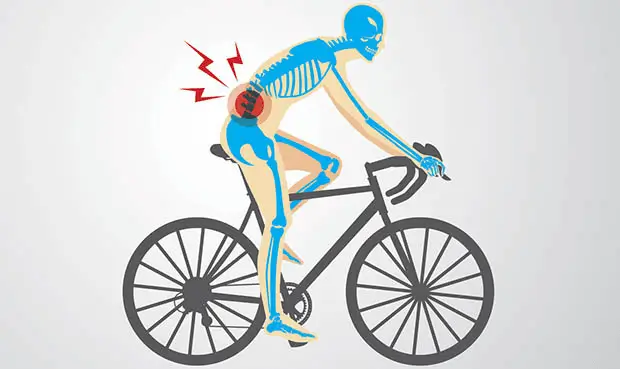
Does Cycling Really Affect Men's Health Below The Belt? Here Is The Truth
Up to 91% of male cyclists report perineal numbness at some point, but the data on lasting damage is far messier than the scare headlines suggest.
This guide shows what causes pain (fit, tight hips/IT band, weak glutes/core), how to fix it based on where it hurts, and how to prevent it.

Cycling has a reputation for being the “knee-friendly” cousin of running. Smooth, circular motion. Low impact. Long, scenic rides that feel like therapy on wheels.
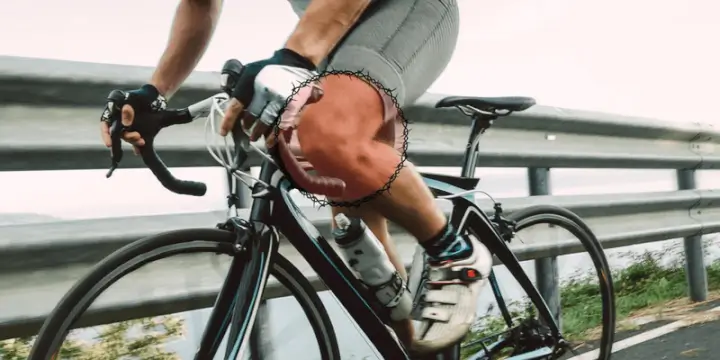
And yet… knees still rebel.
If you’ve ever finished a ride only to feel a dull ache, a sharp pinch, or a strange pulling sensation around your knee, you’re not alone. Cycling knee pain is surprisingly common, and here’s the twist: it often comes from the exact same root causes as runner’s knee.
The bike isn’t the villain. It’s more like a spotlight. It exposes what your body has been quietly compensating for all along.
This guide will walk you through:
Let’s get your knees back to feeling like precision-engineered hinges instead of grumpy door joints.
Cycling is low impact, but it is high repetition.
Each pedal stroke may feel gentle, but multiply that by thousands of rotations per ride and suddenly even a small imbalance becomes a loud, persistent problem.
Research backs this up. A study published in the American Journal of Sports Medicine found that 94% of professional cyclists experienced overuse injuries in a year, and 23% reported knee pain.
So if elite athletes with perfect gear and coaching still struggle, it’s not about weakness. It’s about mechanics.
Cycling knee pain usually comes down to one thing:
Your knee is being forced to move in a way it wasn’t designed to.
And when that happens repeatedly, irritation turns into inflammation, and inflammation turns into pain.
Most cycling knee pain is related to patellofemoral pain syndrome (PFPS), commonly known as runner’s knee.
Despite the name, cyclists get it too.
What’s happening under the surface?
Your kneecap is supposed to glide smoothly along a groove in your thigh bone. When your muscles are balanced and your alignment is correct, it moves like a train on rails.
But if something pulls it off course even slightly, it starts grinding.
Not dramatically. Not instantly. But enough to create friction, irritation, and eventually pain.
Let’s zoom out and look at the usual suspects. Think of these as invisible hands subtly tugging your knee out of alignment.
When your hips are tight, your knee drifts sideways during the pedal stroke. It’s like steering a car with misaligned wheels.
The IT band runs along the outside of your leg and can pull your knee outward. If your inner thigh muscles aren’t strong enough to counterbalance it, your knee loses its center line.
This one is almost legendary in physical therapy circles.
Weak glutes = overworked quads = overloaded knees.
When your glutes don’t do their job, your knee becomes the reluctant overachiever.
If you’re pushing through your toes instead of the full foot, your knee stays in a more flexed position, increasing strain.
This is a big one.
Your bike should feel like an extension of your body, not a puzzle you’re constantly adjusting mid-ride.
Jumping into long rides too quickly is like asking your body to learn a new language overnight.
It understands… but it complains loudly.
The location of your knee pain is a clue. Your body is leaving breadcrumbs. Let’s follow them.
This is the most common type.
You might feel:
Likely causes:
How to fix it:
Quick relief tools like kinesiology tape can help, but they’re a bandage, not a solution. The real fix is correcting movement patterns.
Pain behind the knee often feels like tightness or pulling.
Likely causes:
How to fix it:
Your pedal stroke should feel fluid, not like you’re reaching for the pedal at the last moment.
This type of pain can feel sharp or localized.
Likely causes:
How to fix it:
Often linked to IT band issues.
Likely causes:
How to fix it:
Cycling looks like a leg-driven sport, but the real control center is your core.
Your glutes, abs, and lower back stabilize your entire movement. When they’re weak, your body compensates.
And guess who ends up paying the price?
Your knees.
A classic sign: your knees collapsing inward toward the bike frame during pedaling. That’s your glutes waving a tiny white flag.
You don’t need a two-hour rehab routine. A few targeted exercises can make a dramatic difference.

Multi-directional lunges that train stability and control. Great for balancing strength across the hips and thighs.
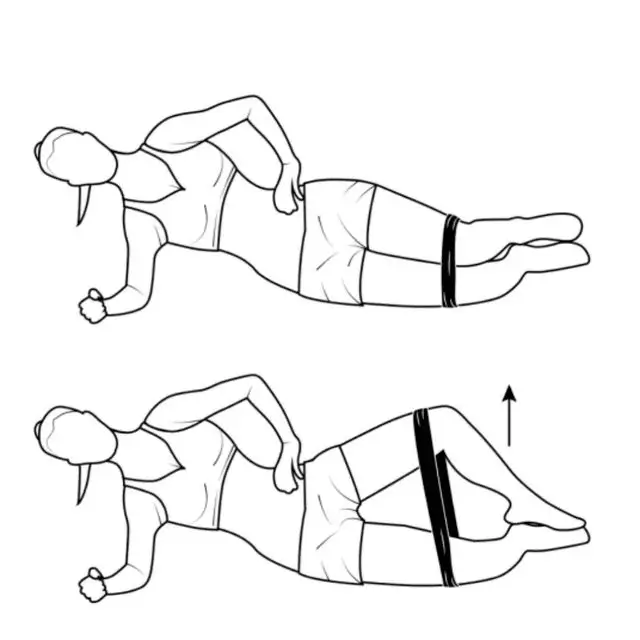
Builds strength in the outer hips and glutes. Small movement, big impact.
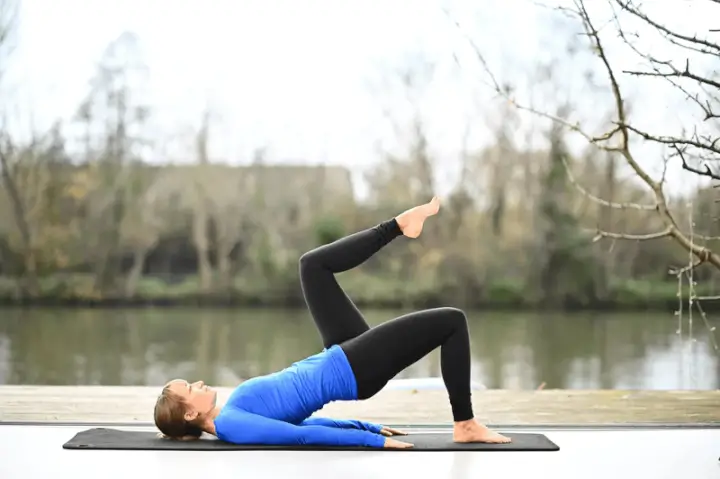
Strengthens glutes and core while teaching your body to stay stable under movement.
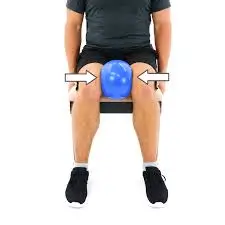
Activates inner thigh muscles that help keep your knee aligned.
Consistency matters more than intensity. A few minutes regularly will outperform occasional long sessions.
If you want to avoid cycling knee pain entirely, think of it as a three-part system:
Even small adjustments can have huge effects. If possible, get a professional bike fitting.
Focus on:
Not just quads and calves.
Increase distance and intensity slowly.
Your body adapts, but it needs time.
If knee pain is starting to limit how long you can stay on the bike, it may not be just about overuse. In many cases, weak muscles and poor nerve activation around the knee can make the joint less stable, especially during long rides.
One solution that many riders are trying is Ageless Knees, a simple at-home program that combines gentle exercises with a small massage tool designed to stimulate the femoral nerve and support the muscles that protect the knee.
The routine only takes a few minutes a day and is designed to improve mobility without heavy training or impact.
You can learn more about how it works here.
Perfect for the new riders!
No spam. Cancel anytime.